д-р Никола Бенин


д-р Никола Бенин
д-р Никола Бенин


Nikola Benin, Ph.D


Nikola Benin, Ph.D
It is said that Dante would frequent the Piazza del Duomo in Florence on summer evenings, perch himself on a ruin, exposed to the cool breeze, and remain there until dark.
In his work entitled La Vita Nova, Dante wrote that in 1291 he used to sit with his hand and think about Beatrice, drawing an angel with his finger over a few small clouds.
Beatrice had died the previous year. It is therefore almost certain that the legend of the stone of Dante is based on actual events.
Dante often remained there alone in thought, occasionally speaking with friends who passed by. Also, since he was considered a great sage, many visited him seeking advice.
While the stone of Dante is now lost, an inscription remains indicating the exact location where Dante sat, probably in part to admire the construction of the Santa Maria del Fiore, just recently begun.

The inscription is located between the Piazza delle Pallottole and the Via dello Studio, and relates a humorous episode concerning this habit of Dante:
At one time a friend of Dante, a merchant from Bologna attempted to engage him in a conversation about food. However, the poet would not pay any attention to him.
Finally, the merchant asked him: “what is your favorite food?” Without looking at him, Dante replied: “the hard-boiled egg”.
The merchant then went away, and many months passed.
When the merchant returned to town for business, he wanted to see the progress of the construction of Santa Maria del Fiore and passed nearby. He found Dante in the place where they had met months earlier, still deep in thought.
Wanting to play a trick on Dante undetected, he came up from behind him and, remembering the poet’s last reply, asked him: “… with what?” Without hesitation, Dante replied: “with salt.”
This anectode is a favourite among the Florentines, who see themselves as shy and slightly eccentric, but intelligent and witty, like Dante.

Nikola Benin, Ph.D
Dante Alighieri was an Italian Medieval poet, moral philosopher, political thinker, and author of the poetic trilogy, The Divine Comedy, whose first part lends its name to Dan Brown’s novel Inferno.
He is widely considered the major Italian poet of the Middle Ages and is recognized as the father of the Italian language.
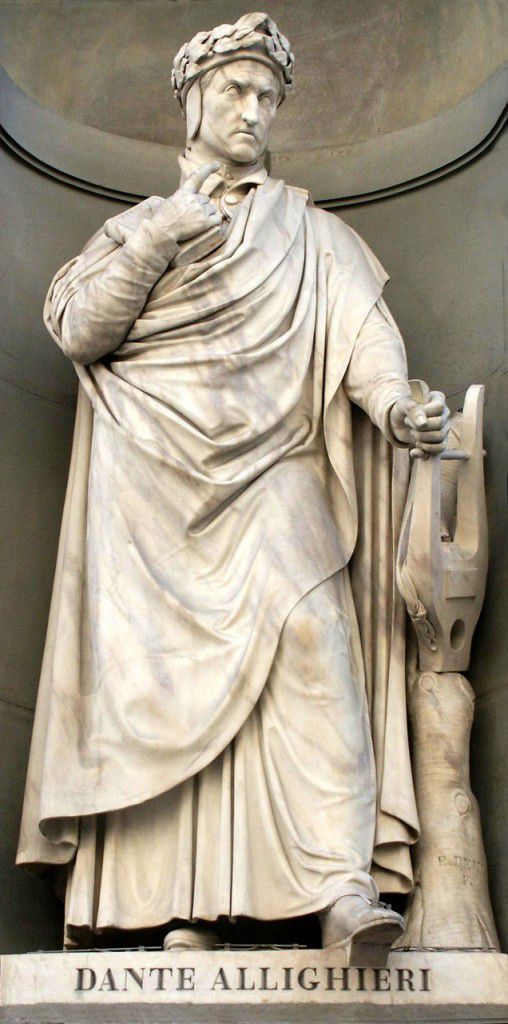
Dante Alighieri, in full, Durante degli Alighieri, was born in Florence in 1265 and died in Ravenna in 1321.
He was the son of Alighiero di Bellincione and Bella degli Abati, the latter of which died when Dante was not yet ten years old.
Dante’s family had loyalties to the Guelphs, a political alliance that supported the papacy and that was completely opposed to the Ghibellines, who were backed by the Holy Roman Emperor.
When Dante was 12, he was promised in marriage to Gemma di Manetto Donati, daughter of Manetto Donati, member of the powerful Donati family.
They were married around 1285, but by this time Dante was in love with another woman, Beatrice Portinari, whom he first met when he was only nine. His love for Beatrice would be his reason for poetry and for living, together with his political passions. In many of his poems, she is depicted as semi-divine, and watching over him constantly and providing spiritual instruction.
Beatrice died unexpectedly in 1290; five years later, Dante published Vita Nuova (The New Life), a work composed of verse and prose. It contains 42 brief chapters with commentaries in 25 sonnets, one ballata, and four canzoni; a fifth canzone is left dramatically interrupted by Beatrice’s death.
The story is quite simple and details his tragic love for Beatrice. The New Life is notable because it was written in Italian, whereas most other works of the time appeared in Latin.
Around the time of Beatrice’s death, Dante began to immerse himself in the study of philosophyand the machinations of the Florentine political scene.
Florence was a tumultuous city, with factions representing the papacy or the empire, namely the Black Guelphs and The White Guelphs, who were continually at odds. Dante held a number of important public posts as a White Guelph.
In 1301, Charles of Valois, brother of King Philip IV of France, was expected to visit Florence because the Pope had appointed him peacemaker over Tuscany. However, since it was believed that Charles had received other unofficial instructions, the city council sent a delegation to Rome to ascertain the Pope’s intentions. Dante was among the delegates.
Pope Boniface VIII quickly dismissed the other delegates and asked Dante alone to remain in Rome. At the same time, Charles of Valois entered Florence with the Black Guelphs, who in the next six days would destroy much of the city and kill many of their enemies.
In 1302 a new Black Guelph government was instituted and Dante was exiled from Florence for the rest of his life. Although Dante was driven out of Florence, this would be the beginning of his most productive artistic period.
During his exile Dante traveled and wrote, and completely withdrew from politics.
In 1304, he went to Bologna, where he began his Latin treatise De Vulgari Eloquentia, in which he urged that courtly Italian, used for amatory writing, be enriched with aspects of every spoken dialect to establish Italian as a literary language.
In March 1306, Florentine exiles were expelled from Bologna, and Dante ended up in Padua.
In 1308, Henry of Luxembourg was elected emperor as Henry VII. Full of optimism about the changes that this election could bring to Italy, Dante wrote his famous work on the monarchy, De Monarchia, in three books, in which he claimed that the authority of the emperor is not dependent on the Pope but is granted to him directly from God.
Around this time, he began writing his most famous work, The Divine Comedy, which he completed in 1317 in Ravenna, where he lived till his death in 1321.
The Divine Comedy is an allegory of human life presented as a visionary trip through the Christian afterlife, written as a warning to a corrupt society to steer itself unto the path of righteousness.

The poem is written in the first person, from the poet’s perspective, and follows Dante’s journey through the three Christian realms of the dead: Hell (Inferno), Purgatory (Purgatorio), and Heaven (Paradiso).
The Roman poet Virgil guides Dante through Hell and Purgatory, while Beatrice guides him through Heaven.
The journey lasts from the night before Good Friday to the Wednesday after Easter in the spring of 1300, before Dante’s exile from Florence.
The structure of the three realms of the afterlife follows a common pattern of nine circles, with an additional tenth: nine circles of hell, followed by Lucifer’s level at the bottom; nine rings of purgatory, with the Garden of Eden at its peak; and nine celestial bodies of heaven, followed by the empyrean, the highest stage of heaven, where God resides.
The poem is composed of 100 cantos, written in the metre known as terza rima, a rhyming verse stanza form that consists of an interlocking three-line rhyme scheme.
Virgil guides Dante through Inferno where they meet people who have committed specific sins during their lifetime. For each sin Dante notices a specific punishment. For instance, in the ninth circle, occupants are buried up to their chins in ice, chew on each other, and are beyond redemption, fated to eternal damnation.
In the Purgatorio, Virgil leads Dante on a long climb up the Mount of Purgatory through seven levels of suffering and spiritual growth, before reaching the earthly paradise at the top. Here, the poet’s journey represents the Christian life, in which Dante must learn to reject the visible earthly paradise for the heavenly one that awaits.
Beatrice, representing divine enlightenment, leads Dante through the Paradiso. Along the way, Dante encounters those who were luminaries of intellectualism, faith, justice, and love, such as Thomas Aquinas, King Solomon, and Dante’s own great-great-grandfather. In the final sphere, Dante comes face to face with God himself, who is represented as three concentric circles, which in turn represent the Father, the Son, and the Holy Spirit.
The journey ends here with true heroic and spiritual fulfillment.
The Divine Comedy has made Dante one of the most important and recognized poets of the Middle Ages and has assured him the epithet of Sommo Poeta.
Nikola Benin, Ph.D
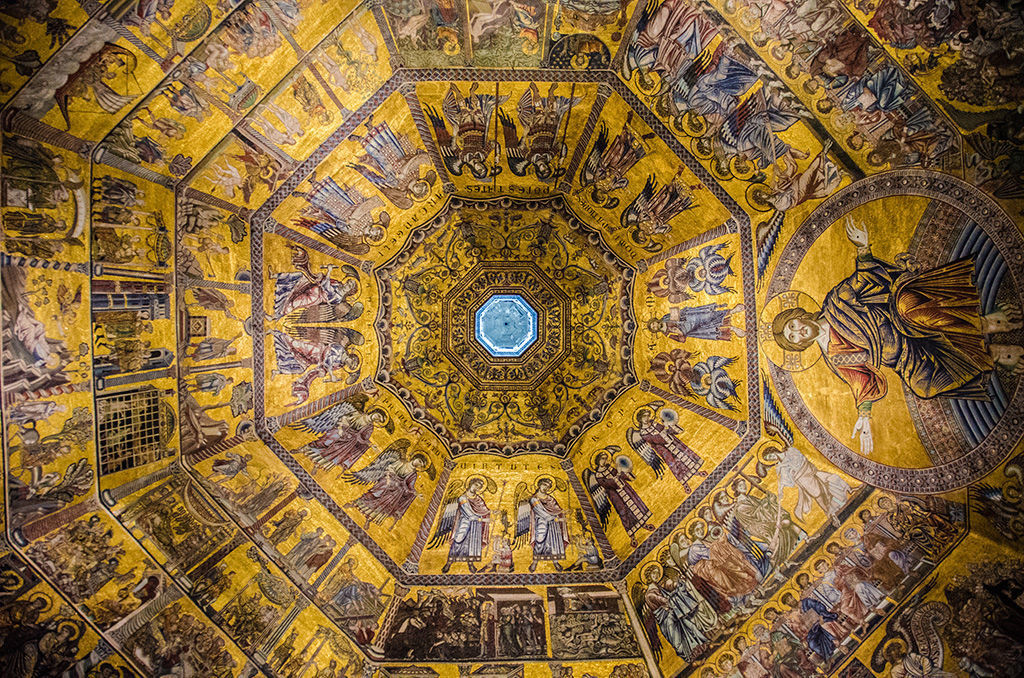
The Florence Baptistery, also known as the Baptistery of Saint John, the patron saint of Florence, is a religious building that stands in Piazza del Duomo, across from the Florence Cathedral and the Campanile di Giotto.
Its origins are in part mysterious.
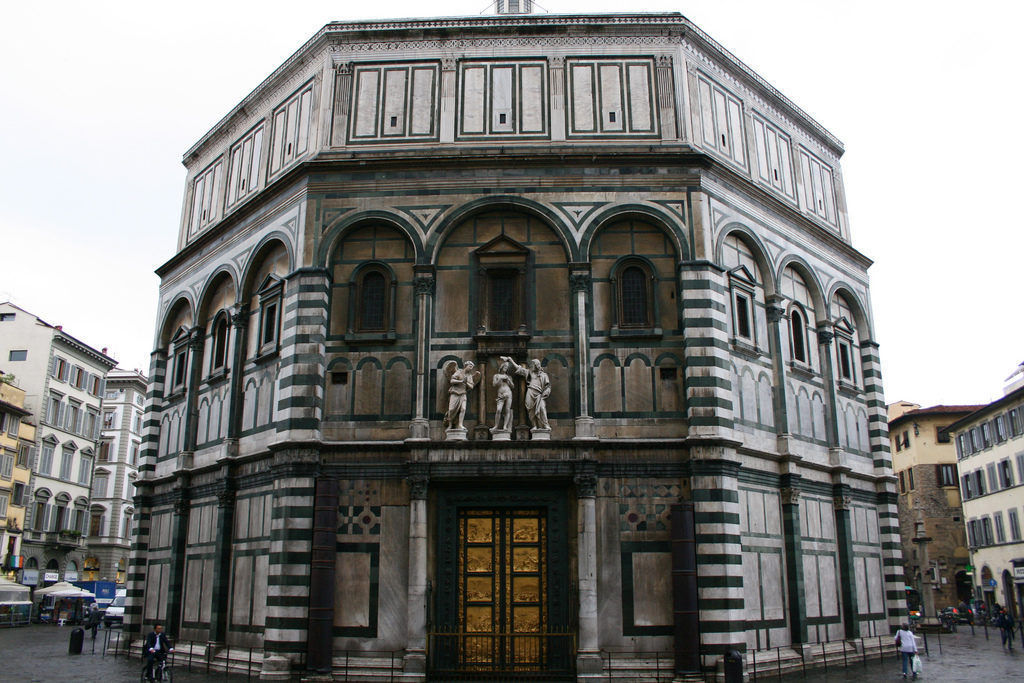
It was long believed that the Baptistry was originally a Roman temple dedicated to Mars, the tutelary god of ancient Florence.
It was first described in 897 as a minor basilica, the city’s second basilica after San Lorenzo, outside the northern city wall, and predates the church Santa Reparata. On March 4, 897, the Count Palatine and envoy of the Holy Roman Emperor sat there to administer justice.
The granite pilasters were probably taken from the Roman forum located at the present site of Piazza della Repubblica.
At that time, the baptistry was surrounded by a cemetery with Roman sarcophagi, used by important Florentine families as tombs.
We know for certain that in 1059, a building with the same structure was consecrated in that location.
The structure in Romanesque style was evidence of the growing economic and political importance of Florence.
It was reconsecrated on November 6, 1059, by Pope Nicholas II, a Florentine. According to legend, the marbles were brought from Fiesole, conquered by Florence in 1078. Other marble came from ancient structures.
The construction was finished in 1128 when it was consecrated as the Baptistery of Florence and as such is the oldest religious monument in Florence.
Up until the end of the 19th century, all catholics in Florence were baptized within its doors.
It also hosted the baptism of also hosted the baptism of Dante Alighieri, who mentions it in his Divine Comedy:
No smaller or no larger they seemed to me
Than are those booths for the baptismal fonts
Built in my beautiful San Giovanni (Inferno, Canto XIX, 16-18)
Dante recalls the ancient medieval baptismal fonts that were still in his time
And one of those, not many years ago,
I broke up to save someone drowning in it:
And let my word here disabuse men’s minds (Inferno, Canto XIX, 19-21)
and said that one day, seeing a child drowning in one of those fonts, he broke a rim in an attempt to save the child.
The Baptistry has a compact octagonal shape (eight equal sides)that conceals a very old symbolic reference: the octagon in the early Christian tradition is the eighth day, when Christ resurrected and started to live forever. This is a clear reference to the rite of baptism.
The sides, originally constructed in sandstone, are clad in geometrically patterned colored marble, white Carrara marble with green Prato marble inlay, reworked in Romanesque style between 1059 and 1128.
The pilasters on each corner, originally in grey stone, were decorated with white and dark green marble in a zebra-like pattern by Arnolfo di Cambio in 1293.
An octagonal lantern was added to the pavilion roof around 1150.
The baptistry was enlarged with a rectangular entrance porch in 1202, leading into the original western entrance of the building, which became an apse after the opening of the eastern door, and faced the cathedral’s western door by Lorenzo Ghiberti in the 15th century.
On the corners, under the roof, are monstrous lion heads with a human head under their claws. They are early representations of Marzocco, the heraldic Florentine lion (the symbol of Mars, the god of war, the original male protector of Florence, protecting a lily or iris, the symbol of the original female patron of the town (Flora, the fertile agricultural earth goddess).
Between the fourteenth and sixteenth centuries, three bronze double doors were added, with bronze and marble statues placed above them.
The exterior is also ornamented with a number of artistically significant statues by Andrea Sansovino (above the Gates of Paradise), Giovan Francesco Rustici, Vincenzo Danti (above the south doors), and others.
The design work on the sides is arranged in groupings of three, starting with three distinct horizontal sections. The middle section features three blind arches on each side, each arch containing a window. These have alternate pointed and semicircular tympani. Below each window is a stylized arch design. In the upper fascia, there are also three small windows, each one in the center block of a three-panel design.
The style of this church served as a prototype, influencing many architects, such as Leone Battista Alberti, in their design of Renaissance churches in Tuscany.
The interior is divided into a lower part with columns and pilasters and an upper part with a walkway. The interior walls are clad in dark green and white marble with inlaid geometric patterns. The niches are separated by monolithic columns of Sardinian granite. The marble revetment of the interior was begun in the second half of the eleventh century.
The rectangular apse was faced with mosaics in 1225.
The baptismal font, dated to 1371, is attributed to a follower of Andrea Pisano and is decorated with six marble bas-reliefs depicting drops of baptism. It is flanked by a candelabrum and a pair of Gothic fonts attributed to a follower of Arnolfo di Cambio.
In front of the altar is a grating that shows the basements, which are home to the ruins of the ancient Roman building with geometric mosaic floors. The ruins were discovered thanks to a series of excavations carried out at the beginning of the twentieth century.
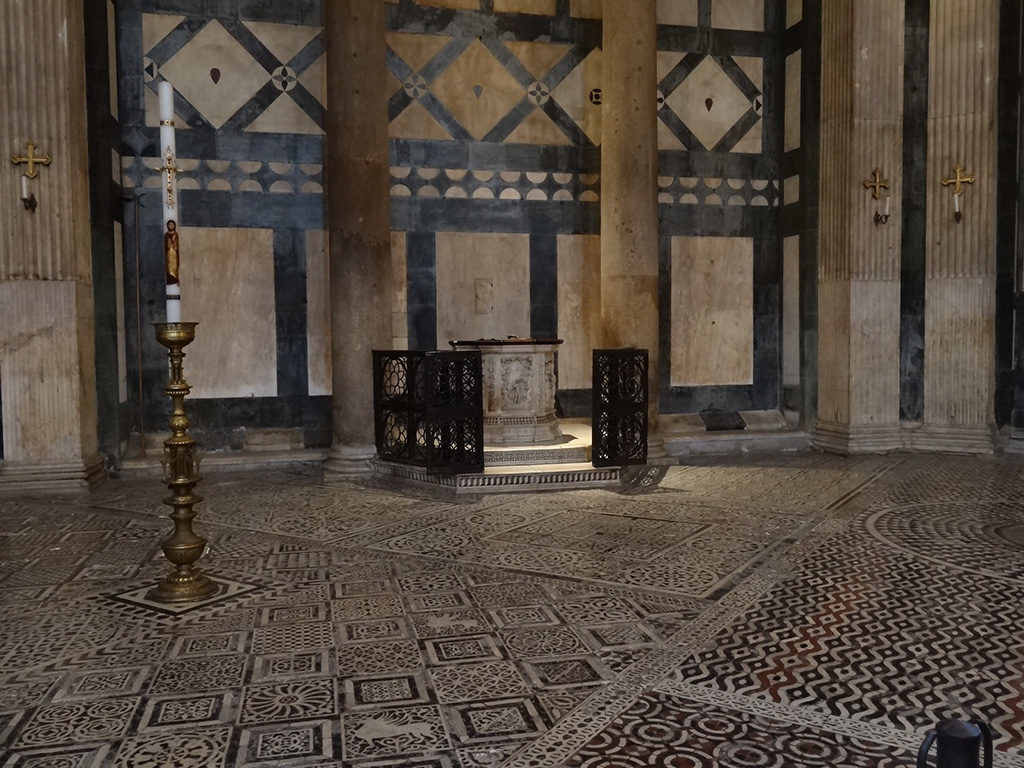
The beautiful interior of the Baptistry is a treasure chest of symbols and mysteries.
The dome and the apse of the Baptistery of San Giovanni are decorated with impressive golden mosaics.
The apse is decorated with images of Christ, the Virgin Mary, the apostles, prophets, and angels, accompanied by images of leaves and plants.
The beautiful celing mosaic dates back to the 13th century and reminds the faithful of the inexorable divine justice in an impressive representation of the Last Judgement. The figures of this work are monstrous and grotesque and recall religious symbols and psalms.
There are many depictions of animals in the mosaics according to the tradition of early Christian symbolism.
The most impressive is the representation of Hell by Coppo di Marcovaldo in which Satan, horned, on a throne inflamed, devouring the damned. Monsters in the shape of a snake, frog or lizard come out from his body. The damned are tortured by many demons in a terrifying scene attributed to Coppo di Marcovaldo as well.
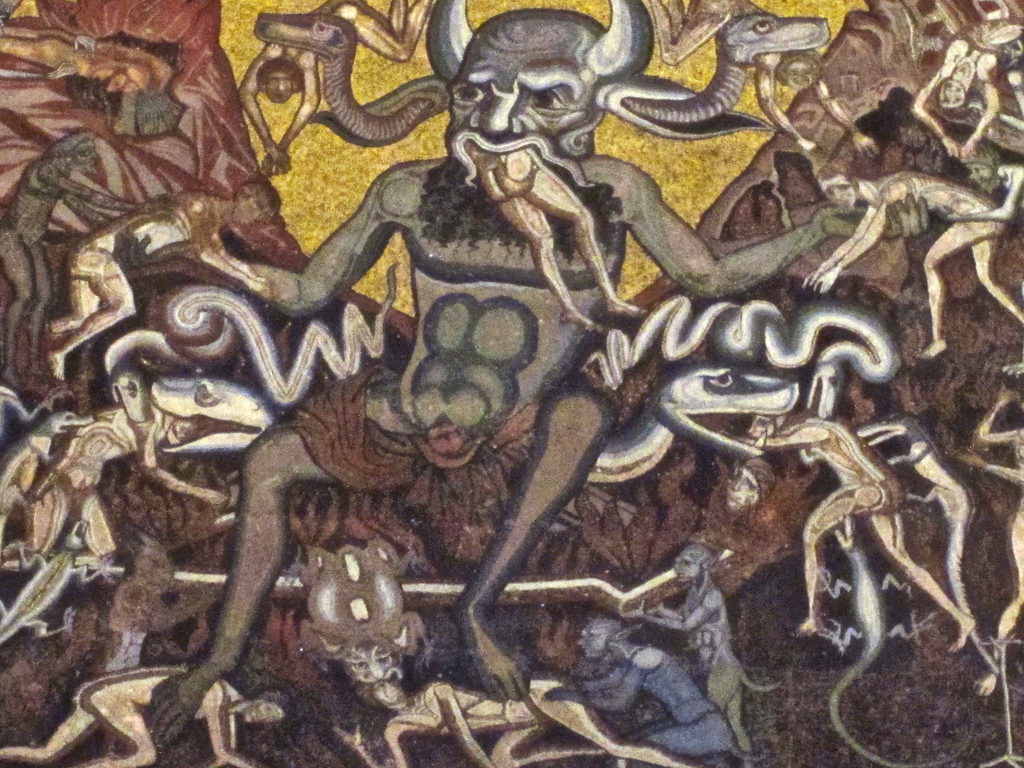
Formerly a hole in the dome, now closed, allowed sunlight to come in and hit the signs of the zodiac on the floor at the North Gate, on which is still written a palindrome, engraved with a blazing sun:
en giro torte sol ciclos et rotor igne
The sign indicated the place where the sun, entering from the top of the dome, would have fallen every year on the summer solstice. On that date, June 24, recurred the feast of St. John, who is the patron saint of Florence.
The most famous work of art in the Baptistry is definitely the Gates of Paradise, one if its bronze doors.
It was made by Lorenzo Ghiberti in mid-1400 and the name of Gate of Paradise was chosen probably by Michelangelo.
The decoration is focused on the theme of sin and redemption…
In Dan Brown’s Inferno Robert Langdon finds next to this door the indication which will lead him to the mask of Dante.
Besides, other elements contribute to make the Baptistry one of the most fascinating places in Florence.
In the Baptistry of St. John is buried Pope John XXIII, considered an antipope by Catholic Church. Persecuted by the official Church, he took refuge by the Medici family in Florence, where he died in 1418. His tomb was built by Donatello and Michelozzo.
Even outside the Baptistry there are a number of mysterious symbols.
A solitary column surmounted by a cross of the fourteenth century stands beside the building. It stands on the spot where a tree miraculously flourished in the middle of winter, when the relics of St. Zanobi were moved from San Lorenzo Basilica to the church of Santa Reparata (which is now under the Cathedral).
On the exterior columns of the Baptistry there are two bas-reliefs representing the foot imprint of Liutprando (King of the Lombards). Legend says that the king imposed a definitive unit of measurement known as the “Lombard Foot” for the trades with Florence.
Nikola Benin, Ph.D
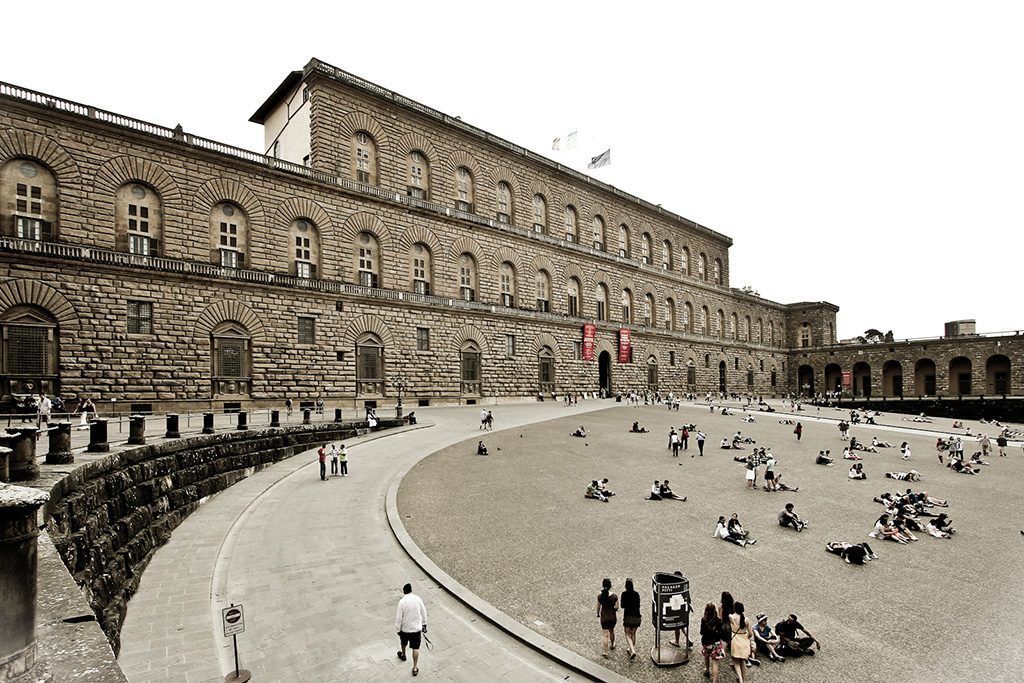
The Palazzo Pitti is a vast, mainly Renaissance, palace in Florence. It is situated on the south side of the Arno River, a short distance from the Ponte Vecchio.
Wanted by Luca Pitti,an ambitious Florentine banker,to challenge the hated Medici family, Palazzo Pitti was, at the time of construction around 1440, the largest and most impressive private residence in the city of Florence.
Even today it is the largest museum complex in Florence.The principal palazzo block, often known as the corps de logis in a building of this design, makes up 32,000 square metres. It is divided into several principal galleries or museums.
Purchased in 1550, the Palace was chosen by Cosimo I de’ Medici and his wife Eleanor of Toledo as the new Grand Ducal residence, and it soon became the new symbol of the Medici’s power over Tuscany. It grew as a great treasure house as later generations amassed paintings, plates, jewelry, and luxurious possessions.
It was also the royal palace of two other dynasties: the House of Lorraine-Habsburg (which succeeded the Medici in 1737) and the Kings of Italy of the House of Savoy (who inhabited it from 1865 to 1871).
At the beginning of the nineteenth century, Pitti Palace was also the residence of the Bourbon-Parma family and then of Elisa Bonaparte, who ruled over Tuscany for a short period.
The construction of this forbidding building was commissioned in 1458 by the Florentine banker Luca Pitti (1398-1472), a principal supporter and friend of Cosimo de’ Medici. The early history of the Palazzo Pitti is a mixture of fact and myth.
According to tradition, Filippo Brunelleschi would have designed the building, but this theory lacks historical evidence.
According to the official version, Luca Fancelli, a collaborator of Brunelleschi, was actually the architect of the Palazzo Pitti.
Besides obvious differences arising from the elder architect’s style, Brunelleschi died 12 years before construction of the palazzo began.
The building has a severe aspect, built with huge, heavy, and rustic stone blocks, the effect of which was perhaps inspired by ancient Etruscan walls.
The severe and powerful aspect is reinforced by the three-times-repeated series of seven arch-headed apertures, reminiscent of a Roman aqueduct.
This original design has withstood the test of time: the repetitive formula of the façade was continued during the subsequent additions to the palazzo, and its influence can be seen in numerous 16th-century imitations and 19th-century revivals.
The technique used to construct the building is similar to that used for other Florentine palaces: large stones at the base and finer and more refined stones at the top.
In the lower part of the façade are two seemingly strange hewn stones: a long one and a short one.
According to legend, it was Luca Pitti who wanted to fix the stones next to each other to symbolize his greatness over the smallness of his enemies.
For the same desire to compete with the powerful Florentine families, tradition says that Luca Pitti had ordered that a courtyard be built. It had to be so big that it would have been able to conten Palazzo Strozzi.
The stones mentioned above are located to the left of the main entrance facing the façade.
The desire to compete with the Medici family and the unfortunate political fate of Luca Pitti, however, soon caused the economic ruin of the Pitti family and the consequent interruption of work at the Palazzo Pitti in 1464.
Work stopped after Pitti suffered financial losses following the death of Cosimo de’ Medici in 1464. Luca Pitti died in 1472 with the building unfinished.
The building was sold in 1549 by Buonaccorso Pitti, a descendant of Luca Pitti, to Eleonora di Toledo, wife of Cosimo I de’ Medici of Tuscany, later the Grand Duke.
On moving into the palace, Cosimo had Vasari enlarge the structure to fit his tastes; the palace was more than doubled by the addition of a new block along the rear. Vasari also built the Vasari Corridor, an above-ground walkway from Cosimo’s old palace, and the seat of government, the Palazzo Vecchio, through the Uffizi, above the Ponte Vecchio to the Palazzo Pitti. This enabled the Grand Duke and his family to move easily and safely from their official residence to the Palazzo Pitti.
Land on the Boboli hill at the rear of the palazzo was acquired to create a large formal park and gardens, today known as the Boboli Gardens.
The landscape architect employed for this endeavor was the Medici court artist Niccolò di Raffaello, known as Tribolo, who died the following year. He was quickly succeeded by Bartolommeo Ammanati and Buontalenti. The original design of the gardens centred on an amphitheatre, behind the corps de logis of the palazzo.
With the garden project well in hand, Ammanati turned his attentions to creating a large courtyard immediately behind the principal façade, to link the palazzo to its new garden.
This courtyard has heavy-banded channelled rustication that has been widely copied in European courts.
Between 1558 and 1577, Ammanati created a monumental staircase to lead with more pomp to the piano nobile. He also extended the wings on the garden front that embraced a courtyard excavated into the steeply sloping hillside at the same level as the piazza in front, from which it was visible through the central arch of the basement.
On the garden side of the courtyard, Amannati constructed a grotto, called the “grotto of Moses” on account of the porphyry statue that inhabits it.
On the terrace above it, level with the piano nobile windows, Ammanati constructed a fountain centered on the axis.
In 1616, a competition was held to design extensions to the principal urban façade by three bays at either end. Giulio Parigi won the commission. Work on the north side began in 1618 and on the south side in 1631 by Alfonso Parigi.
During the 18th century, two perpendicular wings were constructed by the architect Giuseppe Ruggeri to enhance and stress the widening of via Romana, which creates a piazza centered on the façade, the prototype of the cour d’honneur, which was copied in France.
Sporadic lesser additions and alterations were made for many years thereafter under other rulers and architects.
To one side of the Gardens is the bizarre grotto designed by Bernardo Buontalenti.
The lower façade was begun by Vasari, but the architecture of the upper storey is subverted by “dripping” pumice stalactites with the Medici coat of arms at the centre.
The interior is similarly poised between architecture and nature; the first chamber has copies of Michelangelo‘s four unfinished slaves emerging from the corners, which seem to carry the vault with an open oculus at its centre and painted as a rustic bower with animals, figures, and vegetation.
Figures, animals, and trees made of stucco and rough pumice adorn the lower walls.
A short passage leads to a small second chamber and to a third, which has a central fountain with Giambologna’s Venus in the centre of the basin.
The Venus peers fearfully over her shoulder at the four satyrs, which spit jets of water at her from the edge.
The palazzo remained the principal Medici residence until the last male Medici heir died in 1737. It was then occupied briefly by his sister, the elderly Electress Palatine. On her death, the Medici dynasty became extinct and the palazzo passed to the new Grand Dukes of Tuscany, the Austrian House of Lorraine, in the person of Francis I, Holy Roman Emperor.
With he and his wife Johanna of Austria, the palazzo was occupied on a permanent basis and became home to the Medici art collection. Previously, the Palazzo was used mostly for lodging official guests and for occasional court functions.
The Austrian tenancy was briefly interrupted by Napoleon, who used the palazzo during his period of control over Italy.
When Tuscany passed from the House of Lorraine to the House of Savoy in 1860, the Palazzo Pitti was included in the transfer of power.
After the Risorgimento, when Florence was briefly the capital of the Kingdom of Italy, Victor Emmanuel II resided in the palazzo until 1871.
His grandson Victor Emmanuel III presented the palazzo to the nation in 1919.
The palazzo and other buildings in the Boboli Gardens were then divided into five separate art galleries and a museum, housing not only many of its original contents, but also priceless artefacts from many other collections acquired by the state.
The 140 rooms open to the public are part of an interior, which is in large part a later product than the original portion of the structure, mostly created in two phases: one in the 17th century and the other in the early 18th century.
The Palatine Gallery, the main gallery of Palazzo Pitti, occupies the entire first floor of the palace and contains a large ensemble of over 500 principally Renaissance paintings, which were once part of the private art collection of the Medici and their successors.
The lavish Gallery was founded between the end of the 18th century and the first decades of the 19th century by the Habsburg-Lorraine family, who hung about 500 masterpieces in the ceremonial rooms chosen from the main Medici collections.

It is an impressive selection, which includes the largest concentration of paintings by Raphael in the world, as well as invaluable works by Titian, Tintoretto, Caravaggio, and Rubens. The paintings, in their lavish frames, entirely cover the walls of the rooms, which are enriched by sculptures, vases, and tables with semi-precious stone inlays, typical of 17th-century galleries.
The sensational series of baroque frescoes in the “Planet Rooms” (scenes of mythology, nature, and symbolism) by Pietro da Cortona for Grand Duke of Tuscany Ferdinando II de’ Medici, realized between 1640 and 1647 add to the unique charm of the Gallery, where every work of art is enhanced by the setting and the furnishings.
The character of the gallery is still that of a private collection, and the works of art are displayed and hung much as they would have been in the grand rooms for which they were intended rather than following a chronological sequence or arranged according to a particular school of art.
Today Palazzo Pitti, in addition to the palatine gallery with his 28 rooms, houses several important museums: the Silver Museum, the Costume Museum, the Porcelain Museum, the Gallery of Modern Art, the Royal Apartments, and the recently acquired Contini-Bonacossi Collection.
Nikola Benin, Ph.D
Famous for its dramatic icy landscapes, gaping gorges, stunning glaciers, glistening fjords, fascinating wildlife, cold conditions, and for being a remote wilderness, Alaska is often referred to as the USA’s last frontier.
Cruising, fishing, and wildlife spotting are some of the most popular tourist activities in the state.
Separated from the contiguous states by Canada, Alaska was bought from Russia in 1897. It finally became the 49th state in January 1959, some 47 years after the 48th state (Arizona) joined the union. It beat Hawaii, which joined in August 1959, so as not to be the last state to become part of the USA.
Alaska is the biggest state in the USA. It is also the most sparsely populated state, with much of the population concentrated in a few key areas. Additionally, Alaska is one of the least populous states in the nation, having more people than only Wyoming and Vermont and similar population numbers to North Dakota.
Many indigenous groups inhabited the lands in the past, with some still remaining today. It is believed that early Russian settlement occurred in the mid-17th century. The first European boat to land on Alaska’s shores is thought to have been in the mid-18th century, with a settlement established in 1784.
The area was named Alaska during the Russian colonial era, originally only referring to the peninsula and not the plethora of islands that sprinkle the surrounding seas.
Within the Arctic Circle, Alaska’s islands are home to many active volcanoes. The state has in excess of three million lakes, has more than 3,000 rivers, and is home to half of all the world’s glaciers. The USA’s two biggest forests can be found in Alaska. The highest point in North America is located in Alaska—the 20,237-foot-tall Mount McKinley.
It’s fair to say that raw, rugged, and wild Alaska is a fantastic destination for those who appreciate the awesome majesty of Mother Nature.
Many parts of the state cannot be accessed by road or rail. Fly across the pristine landscapes, hop on a snow machine or have an ATV adventure to discover amazing Alaska. While most of the state is pretty much a rare jewel waiting to be explored, here are some especially hidden gems in Alaska:

Bubbly Mermaid Oyster Bar
Not all of Alaska’s hidden gems are natural attractions. The dinky Bubbly Mermaid Oyster Bar is an intimate and chic dining spot in the state’s largest city of Anchorage. It’s tucked away down a tiny side street and it is easy to miss if you don’t know where it is. Stylish and sophisticated, this is THE place to go for a high-class dining experience in the locale.
With a feeling that you’ve been transported to a top-notch bistro in Paris, the Bubbly Mermaid Oyster Bar specialises in oysters and champagne. Indulge in a glass or two of bubbly as you relish delectable bounties from the sea.
Only authentic champagne from France’s Champagne Region is served here. You won’t be short on options, though, with more than a hundred bottles to choose between.
Oysters can be enjoyed raw, baked, or fried, with an enticing assortment of toppings that are sure to make choosing a tough task. A chalkboard advertises other light bites, usually included dishes like garlic toast, bruschetta, seafood cocktail, salad, and crab cakes.
The quirky homemade bar was built using reclaimed wood to look like the front part of a boat. Surrounded by a few bar stools it’s a great spot to strike up conversation while listening to the French music that plays in the background. Oyster shells artfully adorn the walls and hang from the ceilings, and nautical-themed items are placed throughout the small eatery.

Source: Uwe Bergwitz / shutterstock
Eklutna Historical Park
Eklutna is a small village on the outskirts of Anchorage. It is the area’s oldest inhabited place and was originally home to the Dena’ina people, the only members of the larger Northern Athabascan group to live alongside saltwater.
The village was later settled by Russian missionaries, leading to a blend of traditions from indigenous culture and Russian orthodoxy.
Today’s visitors can look around the historic and humble log-built Russian Orthodox Church, the Old St Nicholas Church. Then, visit the New Saint Nicholas Church, a more modern wooden building whose white paint gleams in the sun’s rays and whose burnished onion-shaped domes add to the building’s attractiveness.
A three-barred cross stands in the grounds, and there are many brightly coloured spirit houses in the cemetery. Beautiful spirit houses were erected by the Athabaskan to honour the dead. Here at Eklutna Historical Park, indigenous graves have both a spirit house and a Christian Orthodox cross, combining two very different cultural death rituals. Graves of non-native people are marked with only a cross.
You can combine a visit to the historical park with the blue-green Eklutna Lake, a nice place for picnicking, walking, cycling, camping, and kayaking.
Contained within a family home, the Miller Comb Museum in Homer boasts the biggest collection of decorative hair combs in the world. Whoever knew that anyone would find combs so fascinating?!
The museum has more than 3,000 exhibits, all part of a private collection owned by Mrs Miller. Her obsession with ornamental combs began when she was a beauty school student back in the 1950s. She fell in love with the attractive hair pieces, appreciating that a comb is not only an item to pull through the hair to make it look neat and tidy, but can also be a beautiful accessory.
Mrs Miller’s early married years were financially challenging, living with her childhood sweetheart-turned-husband in a trailer while he tried to eke out a living in the construction industry. Her love for combs never waned, however, and as soon as funds allowed she began to indulge her passion and started to collect antique combs at second-hand markets. She scoured high and low to add to her growing treasure trove.
The collection today contains almost every type of comb imaginable. Big and small, pretty and practical, the combs are made from all manner of materials and adorned with diverse decorative touches. Some are in pristine condition while others show the signs of age. There are combs from all around the world.
If bizarre museum collections are your cup of tea, don’t forget to call ahead and make an appointment to view the extensive comb collection in Homer.

Serpentine Hot Springs
While not exactly in Nome, located a 90-mile flight away, Serpentine Hot Springs can only be accessed by air (in the winter) so it’s a relatively short journey. If you’re feeling active, the hot springs can also be reached by foot in the summer months.
Found within the Bering Land Bridge National Preserve, the hot waters are said to have healing, soothing, and curing properties. Native peoples have long visited the waters to bathe, with indigenous shamans regularly meeting here in times gone by. Healers also took followers to the waters.
The dramatic granite rocks that surround the site add to the rugged beauty, and you can lap up scenic views while soaking. Bathing here is especially surreal during the harsh winter, when the landscapes are covered with thick layers of snow and ice. It might be difficult to actually bring yourself to strip down to enter the water, but when you do you’ll be pleased.
There’s a cabin close to the springs where you can change and store your belongings, and accommodation is available close by.
Spend long days hiking in the peaceful wilderness, looking out for caribou, moose, and bears, and then soothe your muscles in the delightfully warm water.

Goose Creek Tower
A fanciful home that stands alone in the woods of Willow, the unusual Goose Creek Tower pokes up from the trees, reaching towards the sky in all its obscure glory. A narrow river meanders past the property and there are no other dwellings in the immediate vicinity.
Officially named Goose Creek Tower by its creator, a lawyer called Phillip Weidner, people who know of the tower often refer to it as the Doctor Seuss House.
The 185-foot-tall home is the product of Weidner’s imagination turned into reality. It sure helps that he also has a degree in engineering!
Mr. Weidner apparently planned to construct a basic two-floor log cabin in the woods. Ambition and creativity quickly took over, though, with level upon level added to the growing building. There are several interior and exterior staircases and ladders to climb up through the unique building.
The top of the tower provides sweeping views across the surrounding landscapes and front-row seats for the marvellous natural spectacle of the Northern Lights dancingly illuminating the skies in various colours.
Unfortunately, the tower is not open for visitors so you’ll have to marvel at the curiosity from outside. Do respect the boundaries as you gawk in wonderment and remember that it is on private property.

Pasagshak Bay
Kodiak Island is pretty remote in itself, but the scenic Pasagshak Bay brings a new meaning to remoteness.
A hotspot for locals in the know, the area sees few outsiders. It can be reached by road, following a gorgeous stretch of coastline, with the scenic journey being part of the overall experience.
Brave, dedicated, or possibly unhinged, depending on which way you look at it, folk surf in the icy waters, relying on dry suits to protect them from the biting cold. Pasagshak Bay offers plenty of stunning vistas and is a pleasant place for a BBQ and walks along the beach. You may even spot whales swimming through the waves.
Big white buildings loom in the distance; these are part of a commercial rocket launching facility. Detour to Fossil Beach while in the area and see what remnants from the past you can find on the shore. The Fishing Bridge is perfect for keen anglers.

Adak National Forest
Although not officially recognised by official institutions, locals insist that this area is a national forest. With around just 30 trees, it would be the tiniest national forest in the entire nation. Nonetheless, Aleutians are resolute that Adak National Forest is, indeed, a national forest.
Pine trees were originally planted in the otherwise barren area by the US military. An army base was established at Adak in response to Japan having troops on two of the other Aleutian Islands during the Second World War.
The troops were understandably miserable living in the local conditions. To try and boost morale, an army general decided to plant a few pine trees to spread some Christmas cheer among the soldiers.
One lonely tree survived the harsh conditions. Witty soldiers erected a sign that read, “You are now entering and leaving the Adak National Forest”—even the cold and boredom couldn’t snuff out the sass!
Long after the troops left, around 30 more trees sprung to life, beating the climate against the odds. Locals are fond of the tiny forest and decorate the trees with seasonal gaiety every December.

Source: Paul Schenk Photography / shutterstock
Harriman Fjord
Nearby fjords in Prince William Sound may hog most of the attention, but this simply means that those who do visit the stunning Harriman Fjord can have the area almost to themselves.
Spectacular glaciers rise majestically from the waters, including the appropriately named Surprise Glacier and the eight-mile-long Harriman Glacier.
This picturesque jewel was discovered by chance, when an expedition decided to explore a narrow passage. On sailing along the channel they were shocked to find enormous calving glaciers and towering mountains.
The cliffs hide gorgeous waterfalls and you may spot sheep, goats, and bears on the shore. The area is also home to whales, otters, sea lions, and seals, as well as plentiful bird life. Peek down the nearby Ether Passage and you’ll find one of North America’s biggest salmon hatcheries.
Kayaking through the calm waters is possible, with little around you except stunning views and the sounds of nature.
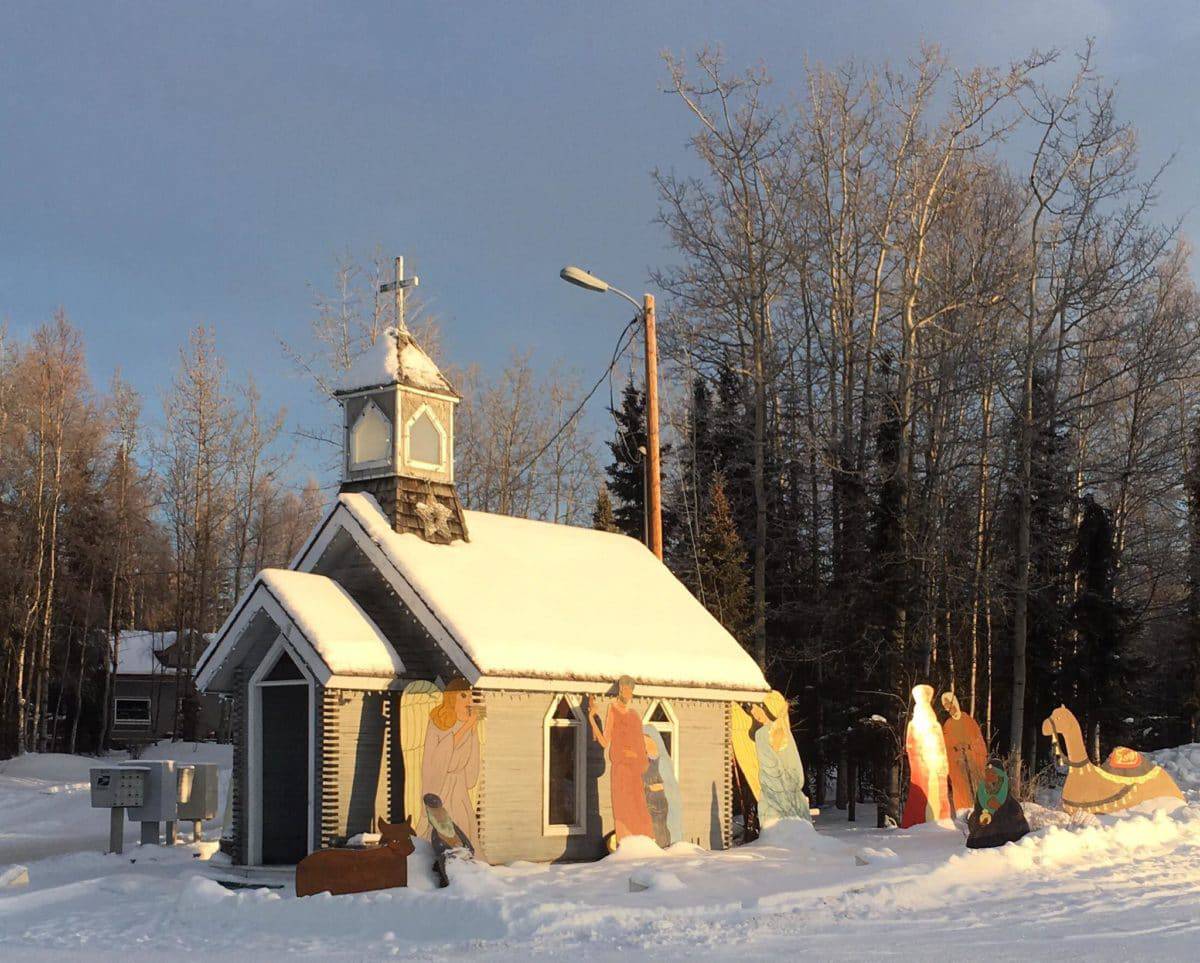
Tiny Church Soldotna
Soldotna is a small Alaskan community on the Kenai Peninsula with around 4,000 people. Fishing is the main source of income for local families.
God-fearing residents can always get closer to the Lord with the village’s Tiny Church. Although the village has a larger and grander church, the adjacent domed Trinity Christian Centre, the bigger building is only open during certain hours of the day. In contrast, people seeking spiritual comfort can access the Tiny Church at any hour of the day or night.
Open around the clock, the Tiny Church provides a peaceful place for prayer and respite from everyday life. Those seeking solitude and tranquility will certainly find it here within the sacred stone walls. A cross stands on top of a small bell tower.
The neighbouring church is also well worth a peek, if open. Even if closed, the half-golf-ball-like design makes for some interesting exterior shots.

Source: melissamn / shutterstock
Igloo City Hotel
A strange and somewhat sorrowful sight in the middle of nowhere, Igloo City is a sad shell in one of Alaska’s remotest areas.
Building of Igloo City commenced in the 1970s, with the intention of creating a nice hotel in the area. The project was never finished, though, due to difficulties in complying with stringent building regulations.
The idea was abandoned, along with the unfinished building, leaving the never-completed hotel to fall to rack and ruin. The years have seen much degeneration, deterioration, and decay.
Though several hopefuls have tried to rejuvenate the site and bring the hotel to life, none have been successful. It still sands forlornly empty, the insides never finished and the rooms having never housed a single guest.
The large four-storey building is now something of an eyesore in the area. Intrepid fans of abandoned premises and urban decay may, however, find something strangely interesting about the never-quite-born Igloo City. Do take care if you sneak a peek inside; you never know which parts are going to break or fall next.

Jilkaat Kwaan Cultural Heritage Center
Klukwan is located a short distance from Alaska’s adventure capital of Haines. The settlement started as a Chilkat Tlingit village alongside a relatively busy trading route. It is the only Chilkat village to remain in the area. The name was derived from a Tlingit phrase that means the Eternal Village.
Klukwan is a great place to see traditional indigenous ways of life in southeastern Alaska. Locals still rely on traditional methods to exist, and the long cultural history is kept alive. The Tlingit language is still spoken here, and rich oral traditions are handed down through the generations. While people swapped communal living for single-family homes, there are a couple of, now-empty, clan houses in the village.
Established in 2016, Jilkaat Kwaan Cultural Heritage & Bald Eagle Preserve Visitor Center seeks to conserve and protect the local heritage and significant artefacts. It’s a fantastic place to learn more about local life and traditions and interact with people who have called the area home for many years.
While still a relatively new site we guess that, as word spreads, this will become a popular attraction on the tourist trail. Visit soon before it’s no longer a hidden gem.

Source: Pecold / shutterstock
Kennicott Ghost Town
Maintained and protected by the National Park Service, Kennicott is an old and abandoned mining town. Sometimes also spelt as Kennecott, it was once a hive of activity with a thriving copper mining industry.
The area drew interest in the year 1900, and within just a few years mines had opened and a town had sprung up. When resources had been depleted and there was no more mining to be done, the mines were closed and the people left. By November 1938, Kennicott had become a ghost town.
Pay a visit today and you’ll find an eerie and deserted area that looks like human life should be present—but it isn’t. You’d be forgiven for expecting to hear the raucous chatter of miners or to see a face appear at a window.
Step into the now-empty miners’ cottages and see where the workmen once lived. Tour the gigantic mill and power station, see the bunkhouses, and visit the now-silent train depot. The red buildings stand in beautiful contrast to the soaring mountains and glaciers in the distance.
If you’re feeling active you can follow one of the area’s hiking trails. Stop by the tiny village of McCarthy, previously a place for fun and hedonism for the miners, and what were once busy hotels, brothels, saloons, restaurants, and snooker halls.
McCarthy is also home to the McCarthy-Kennecott Historical Museum, where you can take a step back in time and learn more about the area’s past.

Bear Lake Seward
A popular swimming destination for locals but little visited by tourists, Bear Lake is the place to go if you want to feel like a true Alaskan. Take a deep breath and jump into the chilly waters for a refreshing summertime dip. Alternatively, try your hand at stand-up paddleboarding.
Don’t fret, though, if you don’t want to get wet; activities like kayaking and canoeing are also a pleasant way to enjoy the shimmering lake without needing to dry off afterwards. Unless, of course, you fall in!
Look out for salmon swimming through the clear waters, sometimes attracting bears who want to fish for their supper. Eagles often soar overhead too, eager to swoop and catch something tasty.
Bear Lake is equally as alluring in the winter months, with ice skating a cool way to glide across the frozen surface. If there’s snow you can enjoy cross-country skiing and snowshoe hiking in the winter wonderland around the edges of the frozen lake.
The lake stretches for two miles. Just a short drive from Seward, it’s easily accessible.

Source: Jef Wodniack / shutterstock
Shrine Of St. Therese Juneau
Situated around 20 miles from the heart of Alaska’s capital of Juneau, the Shrine of St. Therese is on a small tidal island. It is connected by a causeway, though, allowing visitors to get to the shrine easily.
The sacred spot honours the state’s patron saint. Born in a small town in the north of France in the early 1870s, the Carmelite nun died at the young age of 24. Her life may have been short but her impact on Catholics was profound.
In the 1930s it was decided to build a shrine to revere the saint near to Juneau. Hard-working and devoted volunteers collected thousands upon thousands of stones to build the chapel and other structures.
With an external appearance of a structure that could have been lifted right out of rural France, the chapel’s interiors are rather plain. Devotional pictures hang from the white walls and a small cross, flanked by ceremonial candles, sits on the simple wooden altar.
The original Way of the Cross stone structures were built in the 1940s, though newer sculptures were added in the late 1980s. Devout Catholics can work their way around the stations, remembering Christ’s last mortal day.
Follow the Good Shepherd Rosary Trail and admire the replica of The Pieta by Michelangelo. Stroll through the serene gardens and soak up the sweeping views. See the 2001 Merciful Love Labyrinth. Pick up religious gifts and souvenirs from the small shop.

The Golden Eagle Saloon
A rustic and friendly spot in Ester, the Golden Eagle Saloon is relaxed and atmospheric. The establishment also extends a warm welcome to your canine buddies that want to step inside out of the cold. Spruce trees surround the inviting bar.
Some locals look upon the Golden Eagle Saloon as a home from home, though for most outsiders it’s a cool little bar that’s away from the beaten track.
While you shouldn’t expect fancy fare, the eatery is great for affordable, filling, and tasty food. Ramp up the novelty factor and grill your own burger just the way you like it. The indoor grill and stove help to create a rather nostalgic air.
The fire keeps things nice and toasty in the chillier months, and donations for firewood are gratefully appreciated.
You can call in for just a drink too; the saloon has a wide selection of bottled beers as well as draught IPAs, wines, spirits, and soft drinks. How about a game of pool with a friend, old or new?

Upward Sun River Site
Quite a morbid hidden attraction in Alaska, Xaasaa Cheege Ts’eniin is both the name of the site and the name given to the remains of an Ice Age child found at the site. The name translates literally into Upward Sun River Mouth Child.
The skeletal remains date back some 11,500 years and are the oldest human remains to have been found in all of North America. They were discovered in 2011 in what was once an ancient fire pit!
Experts say that the skeleton is that of a girl of around three years of age. Examinations of the skeleton’s teeth indicated a link between the child and both Native Americans and Northeast Asians.
The fire pit where the girl was found was within one of the first permanent dwellings from prehistory to have been uncovered in North America. The presence of animal remains suggests that the pit was used for cooking meals before being used to cremate the child and becoming her gravesite.
There are some people that believe that the fire pit never stopped being used as a hearth, and that the little girl was actually cooked to be eaten! Although this theory isn’t commonly accepted, the fire pit and its remains do give great insights into how early humans survived in this part of the world.
The site isn’t generally open to the public so if you are absolutely dying to visit you should arrange prior permission.

Anchorage Memorial Park
Although not secret in the sense of nobody knowing about it, Anchorage Memorial Park is a hidden gem due to the few tourists who visit the cemetery and the nuggets of history buried—literally!—in the graveyard.
Also referred to as Anchorage Cemetery, the huge burial ground is spread across 22 acres. Established in 1915, it is the city’s oldest cemetery.
So, what’s so appealing about visiting a cemetery while on vacation? Well, this is the final resting place of some of the city’s earliest residents, the people who founded what is now Alaska’s largest city.
Not only a burial ground, though, the cemetery is also a memorial to honour Alaskans who have helped the state to develop and raised awareness of the wilderness throughout the world.
Graves include those of Asa and Alice Martin, early settlers who lived in a tent before acquiring land, constructing a house, and operating a dairy. Their son was responsible for beginning the city’s first clinic. Johnny Jones also lies in the cemetery, a lonely man who failed to achieve his goals of riches.
A fairly new addition to the historic cemetery is the Columbarium Wall. Instead of being buried here, people can also have their cremated remains put into one of the small niches in the attractive wall.

Lady Of The Lake
Eerie, ghostly, and altogether quite unworldly, the Lady of the Lake is an old aircraft that lies half submerged in an Alaskan Lake.
Located within Fairbanks; Eielson Air Force Base, this is one unusual secret gem that may well have to remain hidden; people cannot access the military base without either a visitor’s pass or a military ID card.
If you are lucky enough to be able to enter the base and see the Lady of the Lake you’ll find a retired plane, which was once used to check the weather conditions around the North Pole, in the lake. For aviation buffs, it’s a WB-29 Superfortress.
So, how did the lady end up in the lake in the first place? After being taken out of service in the 1950s, the plane had all her insides and major parts stripped away to leave just a shell. She was then partially submerged in the lake to be used for training purposes.
It’s now too dangerous to use the plane for training so she just stays in the lake, a shadow of her former grand self.

Babbling Book Haines
Calling all bookworms! Don’t miss the cool Babbling Book if passing through Haines. The cute little bookshop has a wide assortment of books, along with stationery supplies, diaries, calendars, cards, maps, small toys, puzzles, posters, gifts, and trinkets.
The store sells a mixture of fiction and non-fiction books. Diverse genres of fiction can be found on the shelves, with romance novels, psychological thrillers, pages filled with horror and gore, action stories, fantasy realms, sci-fi wonders, and more.
When it comes to non-fiction, whether you’re looking for an interesting biography, an educational textbook, a new cookery book, DIY tips, gardening advice, or something else entirely, you’re sure to find something suitable here.
There’s also a good choice of books for kids—it’s never too early to appreciate a good read!
The store has cool seasonal decorations and window displays at some special times of the year too.

Orca Island Cabins Seward
Sitting on a private island and operated by long-term Alaskan residents, Orca Island Cabins are a great place to retreat from the rest of the world, at least for a few blissful and idyllic days.
Get your glamping game on with a stay in a cosy yurt on the island. Each beautiful yurt offers stylish comfort nestled in nature. All are spacious, light, and airy. With a queen-sized bed and a double futon, the yurts are ideal for a romantic retreat, a family getaway, or a fun weekend with friends. Guests also have a private bathroom, a deck with a BBQ, an indoor seating area, and a well-equipped kitchen.
Do not forget that you’ll need to take your own food with you. Drinking water is, however, provided. Yurts come with firewood. You can borrow fishing equipment, paddleboards, kayaks, and small rowing boats to make the most of your outdoor experience.
Your break can be as active or as chilled out as you want it to be. Activities include hiking, whale watching, beach combing, and wildlife spotting.

Source: RUBEN M RAMOS / shutterstock
Hammer Museum Haines
Whether you’re a keen DIY-er, a pro builder, a hammer enthusiast (it could be possible!), or a fan of quirky collections, the Hammer Museums in Haines is an unusual attraction.
As the name suggests, the museum is entirely dedicated to hammers. Big hammers, small hammers, and hammers in almost any conceivable colour are displayed with pride.
The museum is one of the world’s only museums to focus entirely on hammers. We suppose that’s not really all that surprising.
Even if you don’t plan on spending long browsing the collection the museum is still worth a visit to see the gigantic hammer statue that stands in front of the 100-year-old building.
Inside, you’ll find historic hammers that were used by the ancient Romans through to modern-day tools. And, if you thought that hammers were only used for knocking in nails and building stuff, you’d be mistaken. The museum details the many uses of hammers, including by auctioneers, lawyers, doctors, musicians, bankers, and more.
The museum was founded by a man called Dave Pahl. Originally from the state of Ohio, he moved to Alaska for greater self-sufficiency. He learnt the trade of a blacksmith and began to collect tools. He also enjoys restoring old tools and has become something of an expert in hammers.

Source: Adurable Creations / shutterstock
Diamond Creek Trail Homer
Located around four miles outside of Homer, the two-mile-long Diamond Creek Trail is a real local gem. You could call it a diamond of a place.
You can either choose to begin your walk from the start of the tree-lined trailhead, adding approximately an extra mile to your trek, or from the beach for a shorter walk.
Sitting on the pretty Kachemak Bay, look out for local wildlife swimming through the waters and diverse bird life soaring through the skies. Otters, ducks, eagles, crabs, and anemones are likely spots and, if you’re lucky, you may even catch a glimpse of a whale.
The start of the trail leads along a fairly substantial surface, though do watch out for sticky and slippery clay mud. The latter part of the walk is quite a steep descent.
Including beach, tide pools (at low tide), wildlife, and forest, it’s a delightful trail for any active nature lover.

Mukluk Land Tok
Mukluk Land is so quintessentially and stereotypically Alaskan that it’s often said to be the most Alaskan place in the whole state! A kind of whimsical attraction park, Mukluk Land is just outside a small town called Tok, itself often said to be the Gateway to Alaska.
If you’re expecting to see an elegantly arranged collection of mukluks—traditional Alaskan boots made from seal or reindeer skin—you’ll probably be disappointed. There is, however, one saving grace; you’ll find one cool mukluk in the grounds, and it’s the biggest in the world.
Constructed from salvaged items and scrap materials, Mukluk Land contains an assortment of obscure things that would usually have gone straight to the dump or recycling centre. Essentially, it’s a large junkyard that has been given a semi-makeover to become an attraction.
The eclectic items on display include broken snow machines, fire engines that no longer work, a collection of out buildings, and a rather morose mausoleum for departed dolls.
It’s not all doom, gloom, and decay though; cotton candy machines, a trampoline igloo, mini golf, and a whack-a-mole game help to add to the fun factor.
Get into the festive spirit at any time of year when you see the obscure Santa Claus rocket ship.

Fountainhead Antique Auto Museum
Found within the grounds of the Wedgewood Resort in Fairbanks, people not staying here would probably never come to know of this quirky museum’s existence.
Fountainhead Antique Auto Museum takes visitors on a fun journey through Alaska’s modernisation process in relation to the automotive industry and general developments. It’s a must for any car lovers, history buffs, and fans of vintage vehicles.
You’ll find several old cars throughout the grounds that are from before WWII. There are plenty of classic cars to admire too. The collection is rotated regularly meaning that there’s always something new to look at.
Old photos and videos show Alaska life at the turn of the 20th century, with locals struggling to move with the times and facing many challenges with modern (for the day) contraptions. Not to be defeated, however, the way in which Alaskans attempted to adapt vehicles to make them snow-friendly or driveable on rail tracks is both inspiring and entertaining.
See how fashion has changed over the years as you examine vintage clothes from yesteryear. We bet you never even considered the impact the growing automotive industry had on fashion choices before.

Ukivok Abandoned Village King Island
Ukivok was previously used as a winter base for locals who spent their summers at sea or on the mainland.
Built by the Aseuluk people, an Inupiat group that once called the area home at least for part of the year, the small village was ingeniously constructed on stilts on the steep island slopes. When the snowy and icy conditions made fishing and whaling impossible, they would retreat to their winter homes on the tiny island.
During the colder months they relied mainly on seal hunting and crabbing to survive, activities that were a lot easier from an island base.
Sadly, the group was forced to leave the village when the local school was closed down. With the youngsters on the mainland all throughout the year, the adults had little choice but to live on the mainland too.
A fascinating and rather daunting site, the stilt homes still cling precariously to the perilous cliffs, though there is no longer any sign of human inhabitation.

Dockside Galley Ketchikan
A fabulous eatery in Ketchikan, Dockside Galley is secluded away in Knudson Cove Marina. The building may look a little ramshackle from the outside but don’t be fooled; the menu is extensive (though fare is rather basic), the food is delicious, the portions are big, the service is good, and the atmosphere is convivial. A real local hotspot, few tourists find this out-of-the-way establishment.
The restaurant is seasonal, so don’t make your way there on a weekday in the winter months hoping for a feed or you’ll be sorely out of luck.
Burgers and sandwiches are the main meals dished up here. There are heaps to choose from, though, ranging from the classic hamburger, cheeseburger, chicken burger, and veggie burger to a salmon burger, halibut burger, rodeo burger, and jalapeno swiss burger. All come with fries or deep fried shredded potato pieces.
Other dishes include baskets of fried chicken or clam strips, hot dogs, corn dogs, and fish and chips. There’s an extensive assortment of sides to tempt you even more, including onion rings, mozzarella sticks, egg rolls, beer battered mushrooms, fried okra, and fried zucchini. If you’ve still got room left afterwards, why not treat yourself to a sweet dessert too?

Buckner Building Whittier
A crumbling relic that’s shrouded in mystery, secrets, urban legends, and conspiracy theories galore, the Buckner Building was a top secret military base. Unlike regular army bases, though, the entire base was contained inside one gigantic building.
Constructed in the late 1940s, it was referred to as the “City Under One Roof”. Military personnel on this particular base led a self-contained life, holed away from the rest of the world.
In addition to living quarters for soldiers and their families, the base-cum-city had almost everything you would expect to find in a regular small city or army facility.
In common with almost every army base, there was a shooting range, an officers’ lounge, a photo laboratory, and a radio station. Law breakers could potentially find themselves thrown into the small jail.
Leisure facilities weren’t lacking either, with a movie theatre, a small bowling alley, a library, and a large café. Religious members of the secret community could attend mass and worship at the church. When it came to shopping, there was a general store and a bakery. The facility even had a small hospital.
Destroyed by a big earthquake in 1964, it has already been long abandoned, with the military no longer having a meaningful purpose for it.
Today, the Buckner Building is gradually receding back into the mountains, slowly degenerating and failing to withstand the tests of time. Broken, vandalized, and rotting, stagnant water now covers the floors and the walls are coated with mold.
People aren’t really permitted inside, but that hasn’t stopped many a curious soul from taking a peek.

Old Japanese Army Base Kiska Island
Another offbeat military-related place of interest, the old Japanese army base of Kiska Island has some sorrowful stories to tell.
Kiska Island was captured by the Japanese in 1942, during the Second World War. It was one of just a few US areas to be occupied by the Japanese during the war. Japanese troops occupied the island for more than a year, eventually leaving quietly without the resistance troops knowing of their departure.
In 1943, US and Canadian forces attempted to take back the island. The Japanese had already left. Thick fog led to much confusion and disorientation, resulting in the soldiers actually opening fire on each other. Further names were added to the death list when people were caught by deathly traps left behind by the Japanese.
Remote and rarely visited, the island can only be reached by boat. It is strewn with deadly reminders of its tragic past, including guns that no longer work, bullet casings, and Japanese ship wrecks.
Add some of these hidden gems in Alaska to your travel wish list when exploring the USA’s great wilderness and do something a little, or a lot, different to the norm.
д-р Никола Бенин
In the midst of vineyards, Würzburg is a historic university city in Franconia. All eyes are drawn to the two palaces either side of the Main River. On the right bank behind the old town is the UNESCO-listed Würzburg Residence, the Baroque home for the Prince-Bishops of Würzburg, a palace of staggering size and splendour that has the largest fresco in the world.
On the left bank is the Marienburg Fortress, where the Prince-Bishops lived before the 18th century. In between is a city of astounding churches, chapels and museum. Most of these contain works by one of the masters of the Northern Renaissance, the sculptor Tilman Riemenschneider. He produced dozens of religious statues and effigies in the city and was even locked up in the fortress for a time during the 16th-century German Peasants’ War.
A UNESCO World Heritage Site, the palace for the Prince-Bishop Johann Philipp Franz von Schönborn is on a scale that has to be seen to be believed.
Constructed from 1720 to 1744, the Würzburg Residence is among Europe’s great Baroque palaces and is considered architect Balthasar Neumann’s greatest achievement.
The Residence was hit during the Second World War, but its most splendid architecture survived.
The grand staircase is nothing short of dazzling for its self-supporting trough vault that climbs to 23 metres, and painted with a gigantic fresco by Giovanni Battista Tiepolo.
This is the largest fresco in the world and symbolises the four continents: Europe, America, Asia and Africa.
Visiting dignitaries were received in the breathtaking Imperial Hall, a dazzling mass of painting, stuccowork, statues and marble completed at head-spinning expense in 1751.
A permanent landmark on the left bank of the Main, the Marienburg Fortress crowns a spur high above the river, in a spot that has been fortified since Celtic times.
The castle’s story begins in the 1200s when defensive walls were built around Würzburg first church, which had stood here since the 8th century.
For almost five centuries up to 1719 the Marienburg Fortress was the seat of the Prince-Bishops, and it gradually changed from a defensive building into a Renaissance and then Baroque palace after it was almost razed by the Swedes in the Thirty Years’ War.
The Fürstenbaumuseum reveals Würzburg’s 1,200 years of history, and uses period furniture to help you picture the opulence of the Prince-Bishops.
Among the many enlightening things on the tour is the dungeon where Renaissance master Tilman Riemenschneider was imprisoned for allying with the peasants in the 16th century German Peasants’ War.


д-р Никола Бенин
“Кинта де Регалейра” – един екстаз за очите и душата, след който вече няма да сте същите. Защото ако сте на мнение, че „Пена” олицетворява най-необуздания архитектурен хаос и пищност, които някога сте виждали, значи сте в дълбоко заблуждение. Очаква ви делириумният “Кинта де Регалейра” – бесът на неоготиката!
В периода 1697 – 1817 г., това имението честно сменя своите собственици. През 1840 г. е закупено от баронеса де Регалейра, която го трансформира в елегантна лятна резиденция с параклис. Именно тогава придобива и името „Кинта де Регалейра”. Но 50 години по-късно, през 1893 г. чрез публичен търг имотът става притежание на Антонио Монтейро – екстравагантен милионер, натрупал състоянието си в Бразилия. След като се сдобива с двореца, той закупува и околните имоти, придавайки на парцела настоящата му петоъгълна форма. Монтейро, дълбоко повлиян от “възраждащата се” по онова време нео-мануeлинска архитектура, почерпил вдъхновение от структурния и декоративен еклектизъм на двореца „Пена” и нео-мануелинския стил на двореца в Бусаку, проектиран от дизайнера на оперни декори Луиджи Манини (1848-1936). Той го наема да преобрази и неговите 40 000 кв.м. площ. Манини завършва проекта през 1911 г. в резултат на което пред очите ви се възправя най-невъобразимото творение на човешкия гений. Само срещу €6 попадате в развинтената фантазия на Монтейро, който сякаш се е интересувал от всичко, което съществува на този свят и предприемате едно пътешествие по-диво и от това на Алън Куотърмейн в „Рудниците на цар Соломон”. Паркът около двореца сякаш е събрал въображението на Александър Дюма, Жул Верн и Робърт Луис Стивънсън на едно място, само за да бъде увенчано с утопиите и бляновете на Хорас Уолпоул, Ан Радклиф и Мери Шели, към чийто готически романи градините са изпълнени с препратки. Параклисът напр. е построен в нео-мануелински стил и украсен с множество символи на рицарите тамплиери и техните наследници. Таен, подземен тунел свързва криптата с двореца, който пък от своя страна представлява екстравагантно произведение на изкуството – образец на комбинацията между готически, романтичен, ренесансов и масонски стил. Трапезарията е доминирана от огромна камина, която поддържа статуя на дървар, а в Залата на кралете таванът е украсен с портретите на 20 крале и 4 кралици на Португалия, както и с героите на 4 града: Лисабон, Порто, Коимбра и Брага.
Макар на входа на парка да ви дават карта, само след 50 м. тя се превръща в една от онези неясни скици, на които съкровището е отбелязано единствено с червено кръстче. И ако то означава съкровище, значи цялата карта на „Кинта де Регалейра” трябва да е осеяна с червени кръстчета. Защото разходката из тях, без съмнение, е мистериозно преживяване. Безспир, буквално на всеки десет крачки, отвсякъде изникват неописуеми декоративни конструкции като кули, укрепления, проходи, водещи до захапали се един друг тритони и замечтани нимфи, скрити зад загадъчни стени, обрасли с мъх и лишеи, които не ограждат нищо, създавайки една плетеница от скрити знаци и образи. Постоянно се озовавате сред всевъзможни енигматични съоръжения, за които нямате и най-малка представа за какво могат да послужат, тайнствени водопади и покрити с водни лилии езера, дървени мостове, зловещи пещери и мрачни тунели, извеждащи на ней-невероятни места в парка. Цялата градина има втори, подземен план, за разкриването на който ще се нуждаете от фенерче. Той изглежда като вход към отвъдния свят и там никаква карта не може да ви помогне, защото много от тунелите свършват със задънен край, криволичат и лъкатушат, изминавайки цялото разстояние под повърхността или отвеждат до други тайнствени водопади и покрити с водни лилии езера, досущ като първите, поради което вече нямате представа къде се намирате. Стрелки как да се измъкнете от този лабиринт няма. Попадате в истинска готическа атмосфера на първичен ужас и свръхестествен кошмар, че може да се въртите в кръг завинаги, че накъдето и да тръгнете, постоянно се натъквате на капани, каквато е била и първоначалната идея. Въпреки това досега никой не е звънял на номера от картата на екипа на „Кинта де Регалейра” да дойде да го изведе от парка. Имайте предвид все пак, че това са едни от най-сложните градини, които някой някога е създавал, но са толкова умело проектирани, че където и да се окажете, ако тръгнете по някоя от пътеките, виещи се в типично готически стил покрай меланхолични плачещи върби, високи до кръста отровнозелени папрати, напълно разцъфтели камелии и оклюмали глицинии, винаги стигате до „сърцето на парка”: Кладенецът на посвещението! Това е умопомрачителна спираловидна структура, като обърната кула, забита в земята с всичките си 27 м. В стените й са изсечени стълбища, поддържани от гравирани колони, които свързват 9-те нива, олицетворяващи според легендите деветте кръга на ада. Смята се обаче, че разстоянието между площадките, както и броят на стъпалата между тях, са продиктувани от масонските принципи. Затова минаването през 9-те пръстена символизира пречистването на човешката душа, а отделните кръгове от духовното пътуване са разделени с по 15 стъпала. Спускайки се надолу ви обгръща все по-дълбок мрак и само компасът на дъното, изрисуван върху кръста на рицарите тамплиери, който винаги сочи изток, ви напомня, че човек винаги се стреми към светлината. Изходът от мистичния кладенец е през каменна врата, която ви отвежда в подземен тунел и след кратко блуждаене излизате на светло. Ако дръзнете да предприемете това пътуване през съзнанието, въобразявайки си, че просто слизате по стъпала, ще установите окултната сила на Кладенеца на посвещението, каквато между впрочем притежава и целият парк – един магичен свят, където статуите оживяват посред нощ и духове витаят из пищната растителност, придобила сребърен цвят на лунната светлина. Градините на „Кинта де Регалейра” са триумф на нестандартната архитектура, преплела в себе си човек и природа, фантазия и история, романтика и готика. И ужас за непосветените…
Националният дворец, Мавърската крепост, дворецът „Пена”, имението „Кинта де Регалейра” – всички те притежават част от душата на Синтра. Но в нея са още веселият розов дворец „Монсерат” с цвят на дъвка за балончета, лимоненожълтият „Кейлуш” с класически версайски градини, отдаденият на съзерцание Манастир на капуцините, изцяло обгърнат в бръшлян, мъх и лишеи, да не говорим за трамвая, който може да ви откара до Атлантическия бряг само за 40 минути.
Дворецът спокойно може да се нарече мистериозно място, тъй като има голяма осмоъгълна кула, подземни коридори, множество пещери, тунели и загадъчни съоръжения. Твърди се, че имотът крие „алхимични тайни“.
Тайнствената кула представлява подземен тунел със спираловидно стълбище, поддържана от гравирани колони, които се издигат от дъното на кладенец. Кулата има 9 площадки, които според легендите символизират деветте кръга на ада.
Твърди се, че кладенецът е построен от масоните за техния обред на приемане в братството.
Пътуването започва от отварянето на каменната въртяща се врата и спираловидната стълба, след което се преминава през 9-те пръстена, което символизира пречистването на човешката душа от смъртните грехове. Отделните кръгове от духовното пътуване са разделени с 15 стъпала.


 okolosveta